Cats
UncertainIdentity or evidence quality is not strong enough for a firm answer.
Verified against ASPCA/provenance audit 2026-05-06 on May 6, 2026.
Sources
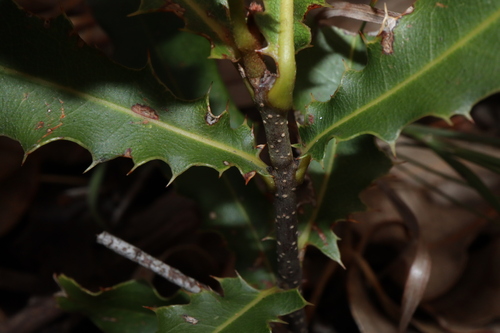
Macadamia integrifolia
Macadamia integrifolia is a tropical evergreen tree known for producing edible nuts, though the nuts themselves are known to cause specific adverse reactions in dogs. While commonly grown for food production, it is occasionally kept as a specimen plant in warm climates.
Safety status
Cats
UncertainIdentity or evidence quality is not strong enough for a firm answer.
Verified against ASPCA/provenance audit 2026-05-06 on May 6, 2026.
Sources
Dogs
Potentially toxicConsulted references classify the plant as toxic or irritating for that pet type.
Verified against ASPCA/provenance audit 2026-05-06 on May 6, 2026.
Sources
If a pet has chewed or swallowed plant material and is showing symptoms, contact a veterinarian or poison resource immediately. This product is for structured reference, not diagnosis.
Cats — concern notes
Common signs
No specific clinical data is available regarding feline ingestion of Macadamia nuts.
Escalation note
Evidence is currently insufficient to determine toxicity in cats; however, owners should prevent ingestion and consult a veterinarian if consumption occurs.
Dogs — concern notes
Common signs
Weakness, depression, vomiting, tremors, hyperthermia, and joint pain or stiffness.
Escalation note
Ingestion can lead to significant discomfort and temporary mobility issues. Contact your veterinarian immediately if your dog has consumed any part of the plant or nuts.
Safer alternatives
No hand-picked alternatives for this plant yet. You can still pick your own using the Compare button on any other plant.
ASPCA Toxic Plant List
toxicology · 99% reliability
Macadamia nut is listed as toxic to dogs, causing weakness, depression, vomiting, tremors, and hyperthermia.
Kew Plants of the World Online
botanical · 95% reliability
Accepted scientific name and botanical distribution for Macadamia integrifolia.
The toxicity of macadamia nuts to cats is currently uncertain — there is no specific clinical data on feline ingestion. While macadamia nuts are well-documented to cause a distinct syndrome in dogs, that reaction has not been reported in cats. Until more is known, treat them as a plant to keep away from your cat.
Watch for vomiting, diarrhea, and signs of abdominal pain such as a hunched posture or refusing food, which can stem from the nut's high fat content. A whole nut also poses a choking or obstruction risk in a small cat's mouth. The classic dog signs — hind-leg weakness, tremors, and fever — are not reported in cats. GI signs, if they appear, typically show up within 12 hours.
Call your vet or the ASPCA Animal Poison Control Center at (888) 426-4435, especially if your cat ate more than a fragment, if the nut was salted, chocolate-coated, or part of a baked good, or if you notice any vomiting, lethargy, or refusal to eat. Even if your cat seems fine, a same-day call is reasonable because feline pancreatitis can take 24–72 hours to declare itself.
Not necessarily — the specific mechanism behind macadamia toxicity in dogs is unknown, and that same syndrome has not been documented in cats. However, the high fat content of macadamia nuts can cause GI upset and potentially pancreatitis in cats regardless of any plant-specific toxin. The evidence for cats is currently insufficient to rule out a risk, so preventing ingestion is the safest approach.
Yes, macadamia nuts are toxic to dogs. Even a small amount — roughly 2 grams of nuts per kilogram of body weight — has been reported to cause clinical signs including weakness, tremors, vomiting, and hyperthermia.
The hallmark sign is hind-limb weakness — dogs may stagger, sit down repeatedly, or refuse to stand. Other common symptoms include vomiting, depression, lethargy, low-grade fever, tremors, and joint pain or stiffness. Initial signs typically appear within 3 to 6 hours of ingestion, with weakness and tremors peaking at 6 to 12 hours.
Remove any remaining nuts from your dog's reach and note how many were eaten and your dog's weight, then call your vet or the ASPCA Animal Poison Control Center at (888) 426-4435 right away — don't wait for symptoms to appear. Do not induce vomiting at home unless directed by a veterinarian. Get to a clinic immediately if you see tremors, an inability to stand, persistent vomiting, or if the nuts were chocolate-coated, as chocolate compounds the risk.
Clinical signs generally resolve within 12 to 48 hours. Vomiting and lethargy usually appear first (within 3 to 6 hours), followed by the more serious hind-limb weakness and tremors peaking around 6 to 12 hours after ingestion. Most dogs recover fully, but prompt veterinary contact is still recommended because severity scales with the amount eaten.
Same safety verdict